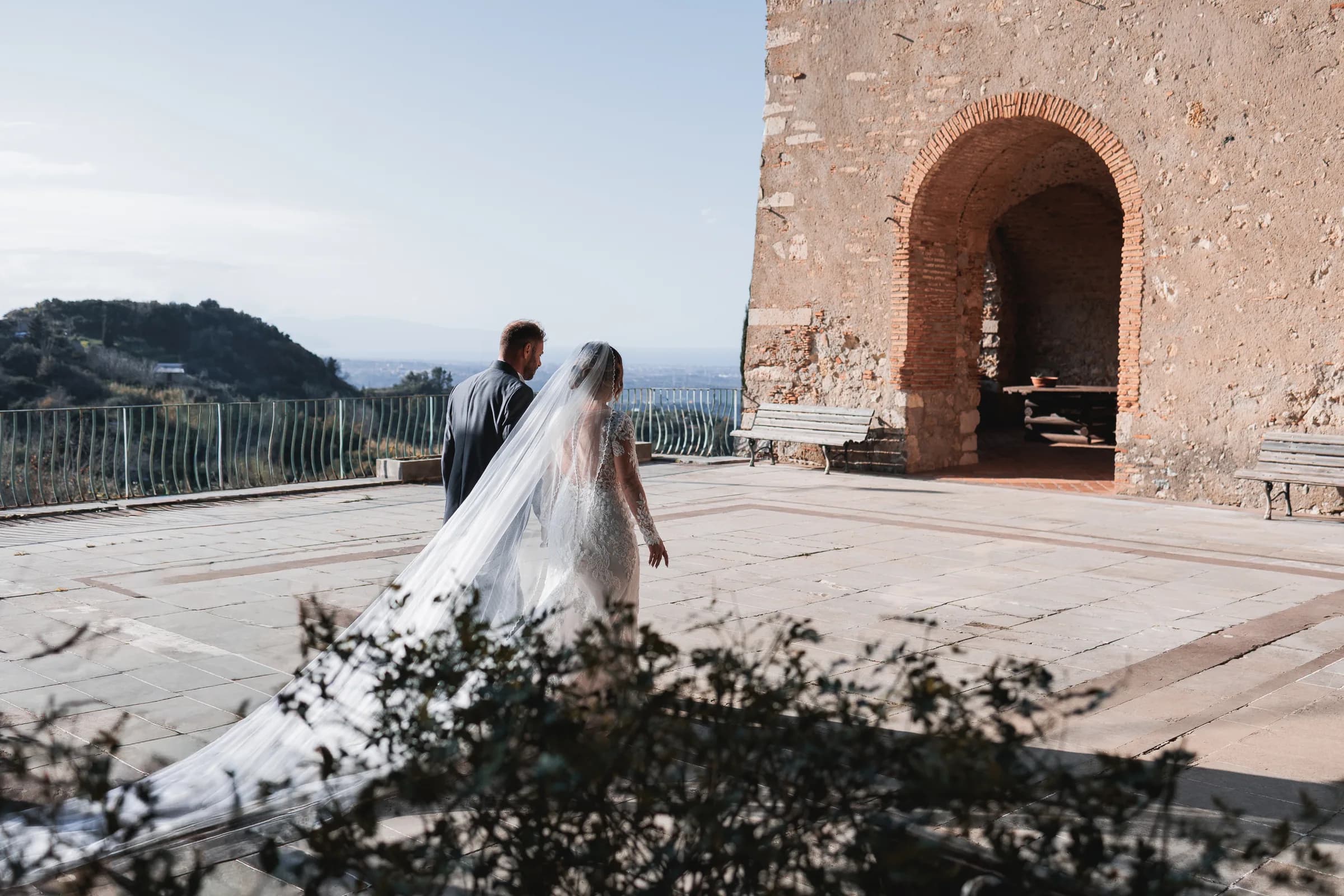
Sicily has a very precise effect on people who see it for the first time. It stuns them. It does it with the light, which is unlike any other Mediterranean light — denser, more golden, able to turn anything it touches into something extraordinary. It does it with the landscapes, which change every twenty kilometres and never look alike: the almost violet blue of the sea at Taormina, on the island's eastern coast, the burnt green of the inland hills, the blinding white of the baroque in Noto, the black of Etna smoking on the horizon.
And it does it with the atmosphere. That sense of suspended time, of an ancient beauty that has never once worried about being current, of a way of being in the world that cannot be explained, only felt.
So it is understandable that every year thousands of couples — Italian and international — choose Sicily for their wedding. And it is understandable that many of them arrive believing that choosing the right venue is enough to have an extraordinary wedding. Sicily will do the rest.
That is the first misunderstanding I want to clear up.
Sicily is an extraordinary setting. But a setting is not a wedding.
Sicily's beauty is real, deep, inexhaustible. It is also, paradoxically, one of the reasons why organising a wedding here is more complex than it looks from the outside.
When the setting is already extraordinary in itself, the temptation is to lean on it. To assume the venue will do all the work, that simply being there is enough to make a wedding memorable. The result, often, is a wedding that looks like a postcard: beautiful in the photographs, but without the narrative thread that makes it truly yours. A wedding that could belong to anyone, in that place.
The other risk, opposite but just as real, is bringing to Sicily a wedding that belongs somewhere else. I have seen couples arrive with a vision built on northern European or New York references — raw wooden pallets, dried flowers, industrial lighting — and try to reproduce it in a baroque villa above the sea. It does not work. Not because that vision is wrong in itself, but because it is in conflict with the space. And when the vision and the space do not speak to each other, you feel a false note that no beautiful photograph can entirely hide.
My work, with weddings in Sicily, begins exactly here: finding the meeting point between your story and this land. Not adapting you to Sicily, not adapting Sicily to you, but building something that is born of the encounter between the two.
My name is Gisa. I was born in Sicily and came back after twenty years in Milan, at the heart of the fashion system. That double perspective — someone who has known this land since childhood and has also looked at it from far away — is perhaps the most valuable thing I bring to this work. In the paragraphs that follow I will tell you what I have learned organising weddings here: the pitfalls nobody warns you about, the timings to respect, the suppliers you will not find online, and why the real Sicily cannot be organised from a distance.
What people coming from outside do not know
Organising a wedding in Sicily from far away — from northern Italy, from abroad, from anywhere that is not here — is an experience with its own specific pitfalls. Not because Sicily is disorganised or unpredictable, as certain cliches would have it. But because it is a land with its own logic, its own timings, its own networks of relationships, its own seasons. And those things are not learned from a website or from Instagram.
The first pitfall is distance. It sounds obvious, but its implications are not. Not being able to visit a venue without planning a trip for that alone means that many decisions are taken on the basis of photographs and videos which, however carefully made, never give back the real experience of a space. The light changes with the hour and with the season. Proportions read differently when you are standing inside them. The sound of the sea, the scent of jasmine, the feel of the air on the terrace at sunset: none of that travels through a screen.
The second pitfall is the network of suppliers. In Sicily, as in any particular territory, there are extraordinary professionals whose visibility online is nowhere near the quality of their work. And there are professionals who are very visible on social media and do not hold up against the real thing. Knowing how to tell them apart, knowing who to call for a certain kind of wedding, who is reliable under pressure, who knows how to work with international couples, who understands a brief in English as well as one in Italian, is knowledge you can only build through years of working on the ground.
The third pitfall, and perhaps the most underestimated, is paperwork. Marrying in Sicily, as anywhere in Italy, means navigating a series of formalities that vary according to the type of ceremony, the nationality of the couple, and the town hall where the marriage is celebrated. For foreign couples, this process can become a labyrinth without a guide who knows it from the inside. Documents to be translated and apostilled, deadlines to be met well in advance, correspondence with municipal offices that each have their own procedures. It is not impossible to handle, but it is handled far better with someone local.
Why knowing the territory is not a detail
When I work with couples who come from elsewhere to marry in Sicily, one of the first things they tell me is: "We want something authentic. We don't want the postcard wedding."
I understand them completely. And I also know that finding that authenticity — the real Sicily, not the one built for tourism — means knowing where to look.
Authenticity is not found in the most photographed venues on Instagram, even though some of those venues really are extraordinary. It is found in the organic winemaker inland who holds private tastings in his eighteenth-century cellar. In the village bakery that pulls the house bread out of the oven at six in the morning and that, if you ask in the right way, will prepare something special for your wedding. In the folk musician who plays an instrument you did not know existed, with a music that comes from centuries of this land's history.
These elements, when they are woven coherently into the vision of the wedding, are what turn a beautiful wedding into an experience guests remember for years. Not because they are folkloric or picturesque, but because they are real. And the real, when it is beautiful, is always more powerful than any stage set.
The seasons of Sicily: when to marry, and why
There is one question almost every couple who wants to marry in Sicily asks me: when is it best?
The honest answer is: it depends on the wedding you want.
The Sicilian summer, from July to August, is the one everybody pictures. Blinding light, crystalline sea, warm evenings that let you stay outdoors until the small hours. It is also the busiest season, with the highest prices and the most sought-after venues already booked one or two years ahead. The heat, especially in the middle of the day, is a variable to be taken seriously when building the timeline.
Spring, from April to June, is in many respects the most beautiful season. The colours are different from summer: the green is still green, the almond trees are in blossom, the light is golden without being violent. The temperatures are ideal. The venues are less congested. And there is something in the spring air in Sicily, a promise, a sense of opening, that marries — literally — the atmosphere of a wedding.
Autumn, September and October, has its devoted admirers. September light in Sicily is extraordinary: warm, dense, with that almost cinematic quality photographs love. The temperatures drop just enough to be comfortable. The grape harvest is under way, and if you love wine and the idea of a wedding set deep in the countryside, there is no more evocative moment.
Winter, finally, is the unexpected choice, and often the one that surprises most. Sicily in winter has a beauty of its own, austere and wild. The great events are over, the cities breathe, the venues become private, intimate places. For a small, gathered wedding with a few chosen guests, it can be the ideal setting.
Destination weddings and the care of your guests
There is one aspect of a destination wedding that often gets considered last, and that instead deserves to be at the centre of the design from the very beginning: the experience of the guests.
Anyone who comes to marry in Sicily brings with them, in most cases, people who do not know this land. People who may never have been to Italy, or who have been but not here. For them, the wedding is not a one-day event, it is a journey. An experience that begins when they book the flight and ends when they get home.
Taking care of that experience — practical information on how to get here, where to stay, what to see and do in the days around the wedding — is not an optional extra. It is an integral part of hospitality. And it is something that, done well, hugely amplifies the value of the whole project: your guests do not only remember the wedding, they remember the journey. And that memory is associated with you.
In Sicily, this has a specificity of its own: the island offers experiences that are not easily found elsewhere. Sunrise hikes on Etna. Boat trips along the coast. Tastings of native wines in historic cellars. Tours of the old markets of Palermo or Catania. Evenings under the open sky in one of the most beautiful Greek theatres in the world. Woven into a programme designed for the guests, these experiences turn a destination wedding into something that goes far beyond a single event.
Why having someone local changes everything
I come back to where I started, because it is the thing I consider more important than all the rest.
Sicily cannot be organised from a distance. Not in the sense that it is impossible — technically, with the right tools, almost everything can be done remotely. But in the sense that the result is different. More generic. Less rooted. Less able to give back what this land really has to offer.
Having someone local, someone who knows this land not as a tourist but as home, who has built relationships with suppliers over time, who knows how things actually work and not how they look online, is the difference between a wedding in Sicily and a wedding that is genuinely Sicilian.
It is not a difference of budget. It is not a difference of grandeur. It is a difference of depth. Of authenticity. Of that rare quality that makes guests, years later, still talk about your wedding as something they had never seen before and have never seen since.
That quality is not found on a website. It is built. With time, with relationships, with a deep knowledge of a land that is extraordinary precisely because it is complex, layered, not immediately legible.
I came back here almost three years ago, after twenty years in Milan. And I have discovered that looking at Sicily with the eyes of someone who has known it since childhood but has also seen it from far away, at the right distance to understand its worth, is perhaps the best perspective I could have brought to this work.
Gisa
P.S. — If you are thinking about a wedding in Sicily and do not know where to begin, the first thing to do is have a conversation. Not a quote, not a list of venues: a conversation. To understand what you really want, and whether I am the right person to help you build it.