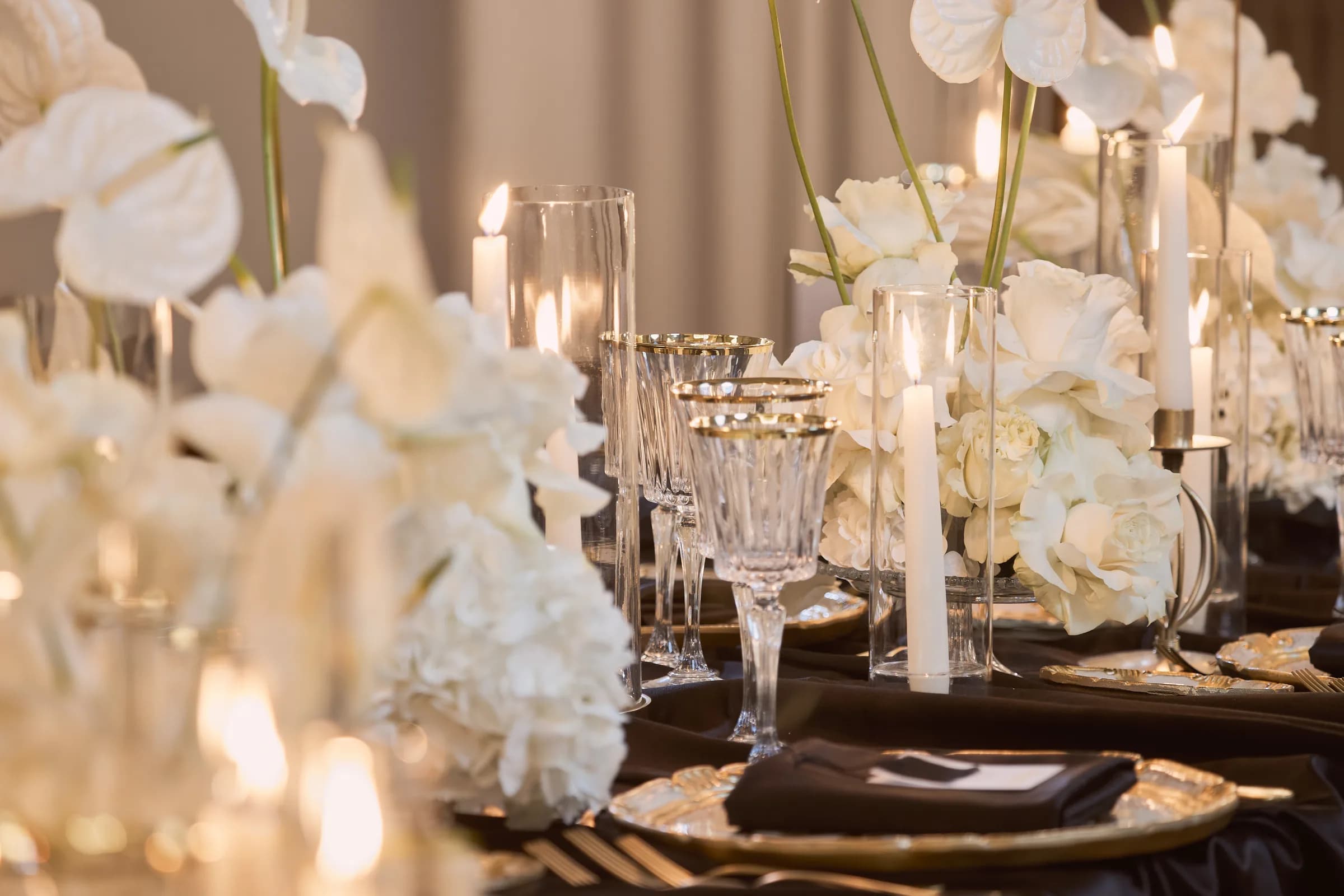
Open Pinterest. You save three hundred images to a moodboard you’ve called "Our wedding." Tables dressed with pampas grass. Arches of white flowers. Candles everywhere. Paper confetti. A bride holding an armful of peonies. Another one, back bare, on a stone staircase.
All beautiful. All the same.
And above all: not one of those images actually says anything about you.
With my experience as a wedding planner and a whole career spent building experiences inside the fashion system, I know this is the moment to stop for a second and start again from the beginning. Not because Pinterest is wrong — it’s a tool, and like every tool it depends on how you use it. But because a moodboard of inspirations is not the vision of a wedding. Between the two there is an enormous difference, and it is exactly that difference that separates a "beautiful" wedding from a wedding that tells a story.
My name is Gisa, and after almost twenty years in the fashion system I have learned that every great project begins with listening. Not with a catalogue, not with a trend — with a story. Today I do the same thing with the couples who choose to entrust their wedding to me: before we talk about flowers, venues or palettes, I look for the thread that is yours alone. In the paragraphs that follow I’ll tell you how I find it — and how I turn it into the compass of your day.
How a vision is really born: the lesson from fashion
In the fashion system, every season begins with a creative brief. The art director doesn’t walk into the studio and say "let’s make something beautiful." He arrives with a precise starting point: an emotion, a period, a place, a tension, a question. Something that isn’t a dress yet, isn’t a collection yet — but is already a direction.
Everything else is built from that starting point. The fabrics are chosen because they answer that direction. The colours are selected because they embody it. The set of the show, the music, the casting — everything serves the same narrative. Nothing is decorative in the pure sense. Nothing is there because "it’s pretty" or because "everyone is doing it."
When I started working with couples, I brought exactly this approach with me. Before talking about flowers, venues, cakes — before even opening a catalogue or walking into a showroom — I look for the brief. I look for the starting point that is yours alone.
And to find it, you have to do the one thing Pinterest cannot do: listen.
The questions that actually matter
My first meeting with a couple looks nothing like what most people expect. I don’t bring samples. I don’t show portfolios of past weddings. I don’t propose anything.
I ask questions.
Not "what style of wedding do you want?" — because that question produces generic answers like "elegant but not formal" or "romantic but modern," which say nothing at all. I ask different questions. The same ones I would ask if I had to build the identity of a brand.
How did you meet, and what do you remember of that moment? Not the official version, the one you tell your guests — the sensory detail, what you felt in the air, the sound underneath it, the light of that place. When you are together and truly at ease, where are you? In a chaotic kitchen, cooking side by side, in a silent café with a book, up a mountain with boots on your feet? What do you wear when you feel most like yourselves? Not for the wedding — in everyday life, when you leave the house and think "yes, today I feel good"?
The answers to these questions are not about weddings. They are about people. And those are the people I have to put at the centre of the project.
Out of these stories come words, mental images, atmospheres. Not a palette yet, not a style yet. But something far more valuable: a genuine emotion to start from. That is the raw material of the moodboard. Not the images found online, but what you already carry inside.
The moodboard as a working tool, not an inspiration board
Once I have gathered this raw material, I build the moodboard. And here lies the fundamental difference with the way it is usually done.
The moodboard I build is not a collection of beautiful images. It is a working tool. It serves three precise purposes: to check that I have understood your story properly, to translate an emotion into a shared visual language, and to create the compass we will come back to every time a decision has to be made.
That compass is perhaps the most underestimated part of the process. When you are six months out from the wedding and you have three different staging proposals in front of you, how do you choose? Without a clear, shared vision, you choose the one that looks most beautiful in that moment, or the one that costs less, or the one the supplier knows how to sell best. And the final result is a pile-up of decisions taken at different times, with no thread holding them together.
If instead you have a compass — if you know that your wedding speaks of intimacy and warmth, of natural materials and low light, of a table laid as though you were waiting for friends to come to dinner rather than staging a theatre — then every choice becomes simpler. Not because there is a right answer in absolute terms, but because there is a right answer for you.
In fashion, this process is called creative direction. In wedding planning it doesn’t have a precise name yet, but it is what makes the difference between a wedding that "looks like a wedding" and one that looks like you.
Why the moodboard alone is not enough
Here I want to be honest about something that isn’t said often enough.
A moodboard, however well built, remains a two-dimensional document. It shows colours, textures, atmospheres. It doesn’t show how those colours will react to candlelight at ten in the evening. It doesn’t show how that texture on the tablecloth will speak to the stone of your venue. It doesn’t show how the emotions you imagined on paper will take shape in a real space, with real people, on a real day.
This is why the moodboard is only the first step of a process, not the whole process.
What comes next is the translation. Carrying that vision into the physical world, measuring it against concrete constraints — the budget, the season, the venue, the suppliers available — and adapting it without betraying it. That takes experience, not creativity alone. It takes having already seen how certain materials behave in certain contexts, how certain suppliers read a brief, how certain spaces react to certain settings.
It is exactly what happens in fashion when you move from sketch to prototype. The sketch is flawless because it exists only on paper. The prototype begins to collide with reality — the fabric falls differently from the way you had imagined it, the construction of the sleeve needs adjusting, the colour under artificial light shifts towards a tone you never wanted. That is the moment you see the difference between someone who can only draw and someone who can also build.
In wedding planning, that moment arrives when you begin selecting the suppliers. And that is where the preparatory work — the listening, the brief, the moodboard — starts to carry its full weight.
From Pinterest to concept: a shift in perspective
If you are reading this article with a Pinterest moodboard of three hundred saves open in another tab, I am not telling you to delete it. I am telling you to use it differently.
Instead of looking at those images and asking yourself "do I want this?", look at them and ask "why did I save this one?". What is it in that photo that made you stop scrolling? The light? The sense of intimacy between the people? The wild green of the flowers? The architecture of the space? The way someone is laughing?
Often what draws us to an image is not the decorative element in itself, but the emotion that element carries. And that emotion is the key. That is the direction.
When I work with a couple, one of the exercises I do most often is exactly this: looking together at the images they have collected and finding the hidden pattern. Not the visual pattern — "you have saved a lot of white and green" — but the emotional one. "All these images share a feeling of gathering in, of a small, protected space, of warm, low light." That is a brief. That is a starting point.
From there we can build something that is genuinely yours. Something that, on the day of your wedding, you will recognise as such — not because it looks like the photos you had saved, but because it looks like you.
The concept as the point of balance between dream and reality
There is one last thing I want to say about the moodboard and the vision, and it is perhaps the most important.
Building a concept does not mean building an unreachable dream. It means finding the point of balance between what you want and what is possible — with your budget, in your venue, in your season. And that point of balance, when it is found well, is not a compromise. It is a synthesis.
I have seen weddings with modest budgets tell beautiful stories, because they had a clear vision and every euro had been spent in coherence with it. And I have seen weddings with important budgets come out confused and anonymous, because there was no thread running through them — only a sum of expensive choices that never spoke to one another.
True luxury, in a wedding as in fashion, is never in the quantity. It is in the precision. In being able to choose exactly what is needed and nothing more, and in making every element serve the same story.
This is what a good concept gives you. Not a catalogue of beautiful things. A map to reach the place you truly want to go.
Gisa
P.S. — In the next article I’ll tell you how the right suppliers are chosen — not simply the good ones, but the ones who speak your same aesthetic language. Because this too, in fashion, I learned to do with method.