There is a precise moment, in the planning of a wedding, when almost every couple feels overwhelmed. It is not when they have to choose the venue, demanding as that decision already is. It is not when they settle the menu, or choose the dress. It is when they find themselves in front of the list of suppliers.
Photographer. Florist. Catering. Musicians. Hair and make-up. Graphics and stationery. Lighting designer. Video. Wedding cake. And then, depending on the wedding, dozens of other roles they did not even know existed until that moment.
For each of these categories there are dozens of professionals. All with a beautiful website, all with a stunning portfolio, all with five-star reviews. How do you choose? On what basis? And above all — how do you tell which ones will genuinely work together, in keeping with the vision you have built?
These are the questions this article tries to answer. Not with a list of generic advice, but with the method I brought with me from fashion: the one a creative director uses to select collaborators not only for their technical skill, but for their ability to serve a shared vision.
The "best in category" trap
The first thing almost every couple does when they start organising their wedding and begin looking for suppliers is to go hunting for the best. The most awarded photographer. The florist with the most followers. The caterer with the best reviews on Google. The reasoning makes sense: if I take the best in every category, the final result will be extraordinary.
In theory. In practice, it almost never works that way.
In my career as a wedding planner I have seen it happen many times, and I saw it in fashion too, where the logic of "the best professional available" collides again and again with the reality of creative collaboration. An extraordinary photographer with a strongly recognisable style — luminous, overexposed, romantic — can be right for certain weddings and completely wrong for others. If your vision is made of shadow, of contrast, of a more austere and contemporary aesthetic, that photographer will bring their vision, not yours. And the result will be a beautiful wedding that, in the photographs, looks like somebody else's wedding.
The same goes for the florist whose arrangements are opulent and theatrical, magnificent in themselves, but out of place if your concept speaks of simplicity and nature. Or for the caterer who works with elaborate, scenographic presentations, when what you had imagined was warmer, more convivial.
The problem is not skill. It is alignment.
What it means to choose with a creative director's eye
In fashion, when you build a collection or set up a showroom, the creative director does not hire the best professionals on the market. They hire the professionals most suited to that particular vision. The difference is subtle, and it changes everything.
Suited means they understand the brief without your having to explain it three times. That when you show them the moodboard, their first reaction is recognition, not adjustment. That their portfolio — not all of it, but at least part of it — already holds something vibrating on the same wavelength as the project.
This does not mean looking for suppliers who have already done exactly what you want. It means looking for suppliers with the right sensibility to do it. The difference matters: a photographer who has never shot a wedding in Sicily can still be the right photographer for your wedding in Sicily, if their eye is the right one. A florist who usually works with minimal installations may surprise you with something unexpected, if you have built a clear brief together and they have trusted the direction.
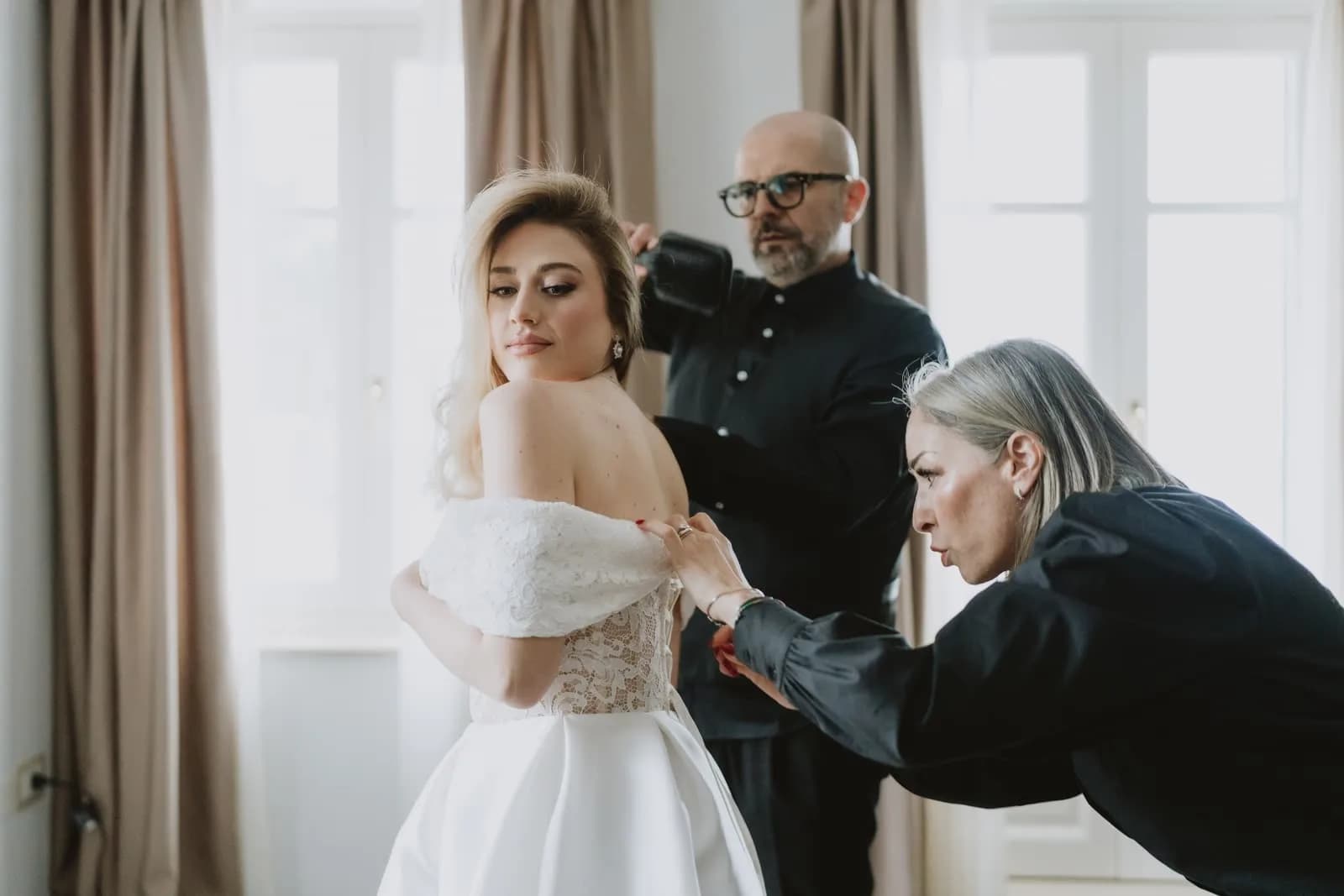
My work, in supporting you as a wedding planner through the planning of your wedding, is to act as a translator. To take the vision we have built together — the moodboard, the concept, the emotional brief — and find the professionals whose antennae are tuned to receive it.
How I read a portfolio (and what I am really looking for)
When I assess a supplier for a wedding, I do not only look at the portfolio. I look at how they look.
What do I mean? In a photographer's portfolio, for instance, I do not linger on the most spectacular images — almost anyone can make those, with the right venue and the right light. I look for the images in the moments of transition: what is the portrait like during the preparations, when everything is still informal and chaotic? What is the reportage like during the cocktail, when the couple are not posing? What happened in that quarter of an hour between one thing and the next, when nobody was watching?
That is where the real eye shows. It is what I found, for example, in the work of Yuliia Hylorenko: a photographer able to stay present in the moments when nobody is posing, and to give back exactly the emotion that was in the air. In the same way, AMF Wedding Film brings that same narrative gift to film — not a chronicle of the day, but a story with a rhythm and a voice of its own.
With florists, I look at coherence. Not so much in the single arrangements as in the way they interpret different spaces. A professional who knows what they are doing adapts their language to the context — a country masseria calls for something different from a noble palazzo in town, and they know it without being told. If I see the same stylistic signature applied rigidly to wildly different contexts, for me that is a signal. It is the opposite sensibility to the one I find in Maiolgae Eventi: every project starts from the couple's palette and atmosphere and is built from there — with a coherence that runs through bouquet, centrepieces, the church and the outdoor spaces, never losing the thread.
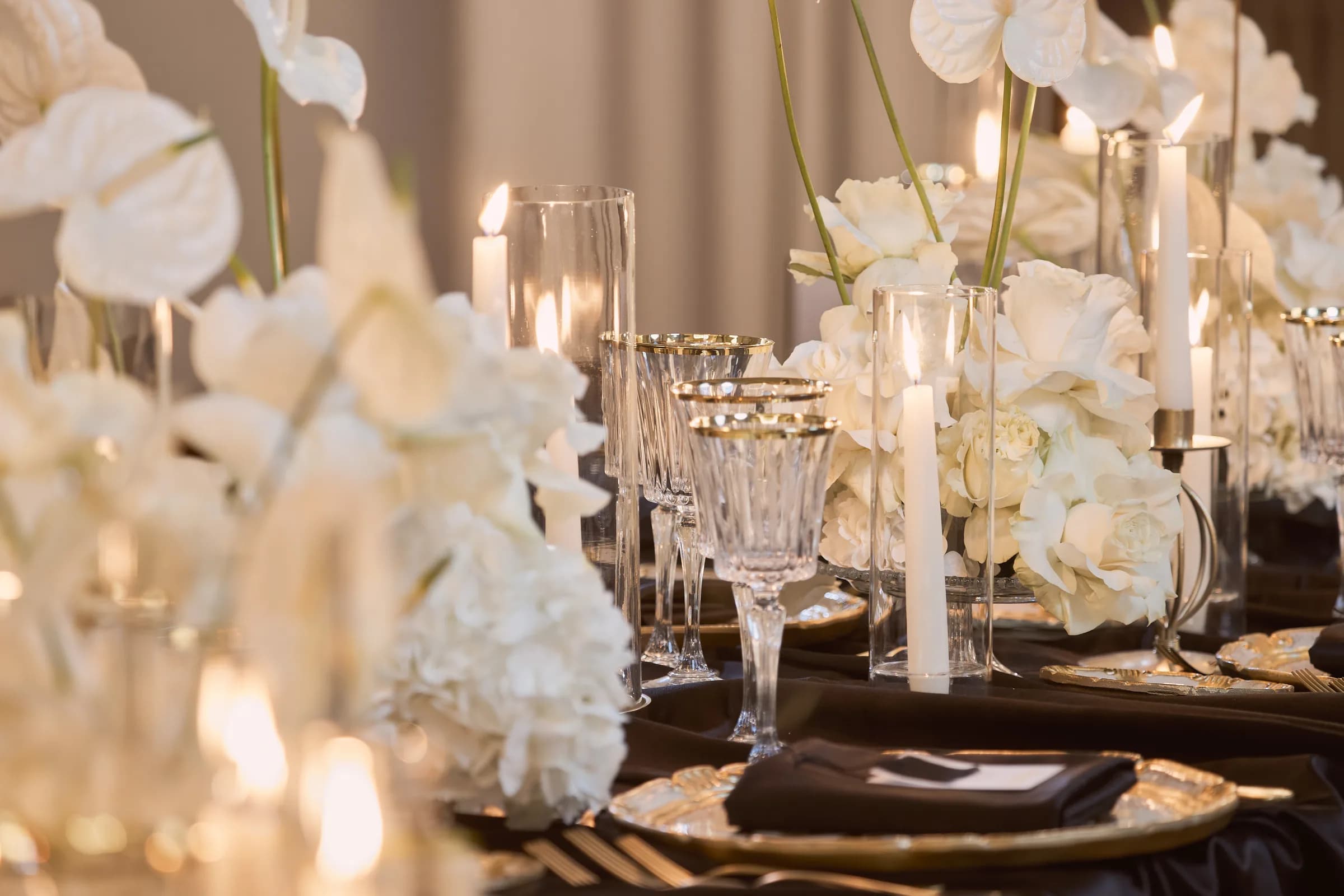
With staging suppliers, I look at precision. Not only in the quality of the single pieces, but in the ability to read the concept and translate it into every element — from the table to the glass, from the set design to the linen. It is what I recognise in Re Banqueting: in the care with which they select and coordinate every detail of the staging there is always a precise overall vision. This is not equipment hire: it is the building of an atmosphere.
And then there is music: often underestimated, when in fact it is what sets the emotional rhythm of the whole evening. Working with a DJ like Davide Del Popolo means having someone who does not run a playlist — he builds an atmosphere, and knows how to modulate it in real time, following the energy of the room.
The first meeting: what I understand in ten minutes
Before confirming any supplier, I always meet the person — not only the professional. A phone call, a video call, when possible a meeting face to face. Not to assess the portfolio further, but to understand how they think, how they listen, how they react to ideas.
Ten minutes of conversation tell me a great deal. Whether they ask questions or wait to be instructed. Whether they warm to the project or stay in sales mode. Whether they hold an opinion — even one different from mine — and can defend it with respect, or whether they simply agree with everything. Total agreeableness, in a creative collaborator, is not a virtue: it is the sign of a missing vision.
The best suppliers I have worked with, in fashion as at weddings, are the ones who bring something of their own without overriding yours. Who listen to the brief, make it theirs, and then reinterpret it in their own voice so that the result is richer than anything I had imagined. That is the kind of collaboration I look for on every wedding.
A coherent team: why suppliers have to talk to one another
There is one aspect of choosing suppliers that is almost always neglected, and that is in fact essential: the coherence of the team as a whole.
Every supplier is good on their own. But a wedding is not the sum of individual performances: it is the result of a collective collaboration that has to run smoothly, often under pressure, often to very tight timings. If the professionals I have selected are not used to working together — or worse, if their approaches and their characters clash — that friction is felt, even when the couple never see it directly.
In fashion, before a show, there is always a rehearsal in which every department works together for the first time as one system. You see the friction. You adjust the timings. You align expectations. In wedding planning you cannot hold a rehearsal of the wedding, but you can do something equivalent: a shared briefing with all the key suppliers, in which each of them not only knows what they have to do, but understands how their work sits inside the project as a whole and how it relates to everyone else's.
This step — which many couples do not even know exists — is often what makes the difference between a day that flows harmoniously and one spent on constant last-minute adjustments.
When budget meets vision: the priorities that count
There is one last thing I want to address, because it is one of the most important conversations I have with couples while we are selecting suppliers.
The budget is not infinite. I know it, you know it, everyone knows it. And in a world where every professional has a different fee and every line of spending seems indispensable, understanding where to truly invest and where alternative solutions are possible takes an overall view that you do not always have when you are inside the process.
My approach is the same one used in fashion to run a collection on a defined budget: you identify the materials — here, the suppliers — that bring the greatest value to the overall narrative, and that is where the investment goes. Everything else is calibrated accordingly.
In practice, it means asking one simple question of every item: is this element central to the story we want to tell, or is it part of the frame? Photography, for example, is almost always central — it is the only thing that remains of the wedding in tangible form, and it is what you will go on looking at for the rest of your life. Flowers, depending on the concept, can be absolute protagonists or can hold a quieter role. Music can make the difference between an evening people remember and one they forget, or it can simply be a lovely background.
There is no single right answer for everyone. There is the right answer for your story, for your style, for what you want your guests to take home with them at the end of the evening. Finding that answer — and helping you build a team of suppliers that truly serves it — is what I do.
It is not a list of contacts. It is creative direction.
Gisa
P.S. — In the next article I will tell you what day coordination really is — and why, on the wedding day, invisible direction is perhaps the most important thing of all. That too, I learned in the backstage of a show.