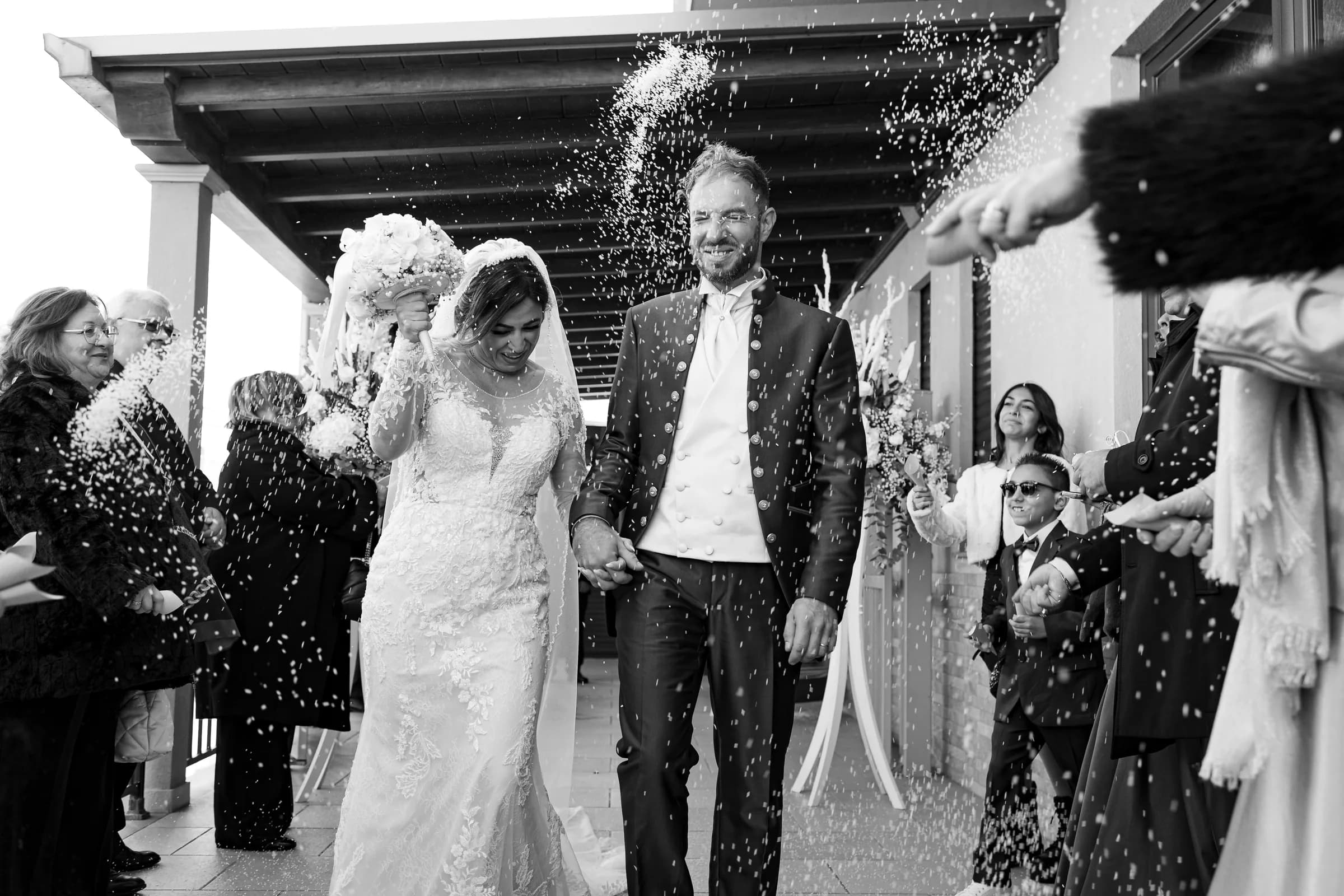
There's a scene that repeats itself, with small variations, at almost every wedding that has no coordinator on the day.
It's eleven in the morning. The bride is still with the makeup artist. The photographer calls because he doesn't know where to go for the portraits. The florist has a question about the settings in the dining room and is waiting for an answer. The caterer has moved his arrival by half an hour and nobody told the venue. The groom's mother wants to know where the cousins are seated. And someone — usually the maid of honour, or the mother — starts running back and forth trying to hold it all together, in her good dress, with her phone burning hot in her hand.
Meanwhile, the bride smiles at herself in the mirror while her hair is being pinned. But underneath, she senses that something isn't right. She feels the chaos. Nobody has said a word to her, and still she feels it in the air.
This is what happens when there is no direction. And this is exactly what day coordination is supposed to prevent.
What day coordination really means
The term gets overused, often misunderstood, sometimes used to sell something far smaller than it ought to be. It's worth being clear.
Day coordination is not "being there just in case". It isn't having someone on call for emergencies. It isn't handing your problems to an outsider once they have already gone off. Day coordination is active direction — structured, continuous, beginning long before the day itself — that lets everything run smoothly because every scenario has already been thought through, every variable already weighed, every supplier already knows exactly what to do and when.
The difference between the two approaches — the safety net and real direction — is the difference between a production assistant who answers emergencies and a production manager who prevents them. In fashion, that distinction is everything. Backstage at a show, you can't wait for the problem to show itself before you solve it. Once the model is on the runway, it's too late. Everything that could have gone wrong must already have been handled.
Weddings work the same way. Or at least, that is how they should work.
Backstage at a show, backstage at a wedding
I'm Gisa, a wedding planner for intimate, elegant weddings in Sicily and beyond. I spent nearly twenty years backstage in fashion — shows, presentations, high-level events — where I learned that the ease you see from the front row is always the result of precise, invisible direction. That same direction is what I bring today to your most important day: so that you can be completely present, certain that behind the scenes there is someone holding it all together.
I spent years backstage at runway shows and collection presentations. At first glance it looks like chaos — dozens of people moving fast in tight spaces, music at full volume, garments everywhere, hair and makeup working in parallel, designers making last-minute adjustments. But anyone who works there knows that under that chaotic surface there is an iron structure. Every person knows exactly where to be and what to do. Every look has its sequence. Every movement is planned. Every surprise already has an answer ready.
None of that structure is visible from the front row. The audience sees only the ease, the elegance, the naturalness with which everything flows. And that is exactly the intention: that the work stay invisible, that the experience of the person watching be pure feeling, with no friction at all.
A wedding works — or should work — exactly like that. The couple are on the runway. The guests are in the audience. And everything happening behind the scenes — the phone calls, the coordination, the improvised solutions, the decisions made on the spot — must never reach either of them.
That is my job on the wedding day. To be the backstage. To be the invisible structure that holds everything together so that you can be completely present in your day.
What really happens in the hours before a wedding
The wedding day begins long before the ceremony. It begins when the first supplier arrives at the venue — often at dawn, sometimes the evening before — and it ends when the last guest leaves.
In those hours there are dozens of variables in play. The florist needs to know exactly how the arrangements go, in what order, with what priorities of time. The caterer needs the final room layout and the timing for every moment of the evening. The photographer needs a detailed timeline that lets him organise the portraits without taking time away from the couple. The venue manager needs to know when to expect the guests, where to send them, when the ceremony will start.
None of this gets improvised on the day. It is built in the weeks before, through a detailed briefing with every supplier, a timeline that accounts for every moment of the day — buffer time for the unexpected included — and clear communication between everyone on the team.
My role as a wedding planner, at this stage, is to be the centre of coordination. The single point of reference everyone can turn to, so that nobody ever has to disturb the couple for anything. That centralising is not only a practical matter: it is a deliberate choice, made to protect the emotional quality of your day.
The timeline: the tool nobody sees and everybody feels
If there is one tool I consider the heart of day coordination, it is the timeline. Not a generic programme with the times of the ceremony and the reception — everyone has one of those. An operating timeline, detailed, bespoke to your wedding and no one else's, accounting for every variable.
How long do the bride's preparations realistically take, given how many people are involved and how complex the dress is? How long for the portraits, allowing for the travel from one location to the next? How long is the ceremony, and what kind of rite is it? Is there a cocktail hour, and how does the flow of guests work in that space? When does service begin, and how do the kitchen's rhythms line up with the evening's programme?
Every moment has its own logic, and every moment shapes the ones that come after. A ceremony that starts twenty minutes late — an entirely normal thing — sets off a domino effect across the whole evening, unless the timeline has already set those twenty minutes aside as margin.
In fashion it is called the production schedule. In any great show, every minute is planned — not to strip out spontaneity, but because real spontaneity, the kind you see from the front row, is the result of a solid structure that holds it and protects it.
The unexpected at weddings: not if, but when
I want to be honest about something people tend to avoid saying: the unexpected always happens. At every wedding, without exception. However meticulous the preparation, however professional the suppliers, however beautiful the venue. Something, somewhere, will go differently from the plan.
A supplier running late. A sudden change in the weather. A technical problem with the music. A guest who feels unwell. A delivery that doesn't arrive in time. The list could go on for a long while, and anyone who has worked in this field for years has seen every kind.
So the right question is not "how do I avoid the unexpected?" but "who will handle the unexpected when it comes?"
If there is no coordinator, that person is you. Or your maid of honour. Or your mother. And at that moment — the moment when you should be completely present, inside the feeling of the most important day of your life — you find yourself instead making an urgent phone call, or taking a logistical decision you never wanted to have to take.
If there is a coordinator who knows the project down to the last detail, who has already spoken to every supplier, who has already mapped the scenarios that could go wrong — that person handles it in silence, and you never learn there was a problem at all. This is not a luxury. It is the condition that lets you actually live your wedding.
Present without intruding: the hardest balance of all
There is a part of day coordination that is not easy to explain, though anyone who has lived it understands at once: the coordinator has to be everywhere without ever being at the centre.
The wedding day belongs to the couple. Every visible decision, every moment the guests see, every feeling in the air has to reflect their story, their style, who they are. The coordinator is the invisible structure that makes all of it possible — not the protagonist.
That takes a delicate balance. Present enough to anticipate every problem, discreet enough never to interfere with the spontaneity of a moment. Knowing when to step in and when to let things run. Having the authority to make fast decisions with suppliers, and at the same time the sensitivity to know when a decision has to go to the couple and when it does not.
I learned it backstage at the shows, where the production manager is the most important person in the room — the one everything depends on — and yet also the one the audience will never see. Their success is measured by how invisible their work is. If you can see their hand, something has gone wrong.
With weddings it is the same. My best work is the work you don't notice.
Why day coordination can't be improvised at the last minute
One last thing.
Day coordination only works if the person doing it knows the project from the inside. Turning up on the wedding day with a list of suppliers and a programme in hand is not enough. You have to have taken part in building the vision, met the suppliers, understood what matters most to the couple, developed the timeline together, mapped the scenarios that could go wrong.
That is why, when I work on a wedding, day coordination is not a separate service added on at the end. It is the natural close of a journey that starts months earlier, the first time we sit down together and begin to build your story.
On the wedding day I don't need to work out what you want. I already know. And that is exactly what lets you stop thinking about it.
Gisa
P.S. — In the next piece I am taking you to Sicily: what it means to plan a destination wedding in a place that is already, in itself, an extraordinary setting. And why having someone local — someone who truly knows that land — makes a difference you cannot calculate in advance.